Queenslanders, especially Far North Queenslanders who are surrounded by two World Heritage Areas, the Great Barrier Reef, and the Wet Tropics Rainforest, expect high environmental standards.
Our community has a deep love for the outdoors, and as a tourism-driven region, we are powered by hardworking, resilient tourism operators. That is why it is essential our regulatory system is practical, efficient, and cuts through unnecessary complexity, so small businesses can focus on what they do best.
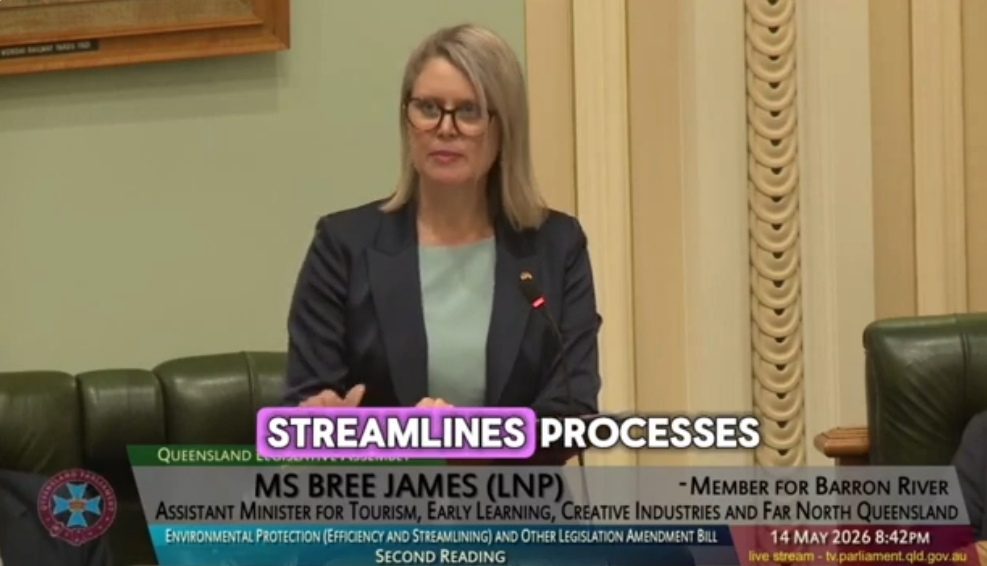
The Environmental Protection-Efficiency and Streamlining and Other Legislation Amendment Bill 2025 delivers on that expectation.
Since becoming the Assistant Minister for Tourism nearly 18 months ago, once of the things the tourism industry has been thrilled with since we came into government is the Minister For the Environment, is also the Minister for Tourism, Science and Innovation.
This has been a game changer for the tourism industry, and a master stroke by the Premier to put these together- which has seen feedback like this come from industry, to help the tourism industry who are also custodians of our environment.
Too often, the tourism industry is painted in a way that isn’t fair. The tourism industry puts science in front of millions of people every single year, whether it’s in a national park or the great Barrier Reef- or one of our incredible eco tourism or tourism assets.
This Bill supports the Crisafulli Government’s Destination 2045 commitment to streamline approvals, reduce duplication and red tape and make it easier for businesses-particularly tourism operators-to operate across Queensland.
It also impacts a wide range of sectors, including tourism, mining and resources, energy, agriculture, forestry, construction, waste management and regional infrastructure.
These changes are particularly important for Far North Queensland, where industries such as ecotourism, agriculture, resources and infrastructure are critical drivers of local jobs and economic growth.
This Bill focuses on three key priorities:
- streamlining regulation
- maintaining strong environmental protections
- supporting economic growth and regional development
It is another important step toward reducing duplication and delivering a more practical, efficient regulatory framework.
For Far North Queensland, this Bill represents a significant opportunity for ecotourism.
Tourism is one of the fundamental pillars of our regional economy.
In Tropical North Queensland alone, visitor expenditure exceeds $3.4 billion annually, highlighting just how critical tourism is to the region’s economy and local jobs.
It supports more than 29,000 jobs, accounting for around one in every seven jobs in the region.
However, operators have consistently raised concerns about complex, duplicative approvals processes that create delays, increase costs and reduce certainty.
This Bill delivers on a key commitment to introduce a more integrated and streamlined approval pathway for tourism activities across multiple land tenures-such as national parks, state forests, recreation areas and marine parks.
In practice, this means moving toward a single, integrated permit system that simplifies approvals and reduces unnecessary duplication and cost, while maintaining environmental safeguards.
Local operators have made it clear what these delays mean in real terms.
Billy Tea Safaris has been operating in our region for more than 40 years, providing four-wheel-drive tours through some of the most remote and environmentally significant areas of the Daintree and surrounding regions.
I have spoken directly with the owner, Peppi, who told me that just last year his business was under significant strain due to delays in the permit approval process.
Despite decades of operating responsibly, he faced a situation where his renewal approval was delayed to the point that he could not plan ahead with any certainty as he would be in breach.
He was unable to pre-sell tours for the following year, which is standard practice in the tourism industry, and he could not confidently promote the region because he did not know whether his permit would be renewed.
That uncertainty had real consequences.
What businesses like this need is certainty.
They need a system that recognises responsible operators, supports low-impact activities, and allows them to invest confidently in the future.
Cairns Adventure Group, an award-winning local business running guided tours to the Daintree Rainforest and Cape Tribulation, has experienced these same issues firsthand.
Like many others, they have had to navigate a complex and duplicative approvals process that creates uncertainty and delays, even for low-impact, well-established operations.
And it is not just land-based operators.
Our reef tourism operators have also been dealing with unnecessary layers of regulation, with some requiring several permits to undertake essentially the same activity.
Importantly, this Bill is not about weakening environmental protections.
Higher-risk activities will still be subject to appropriate scrutiny and oversight.
What this Bill does is ensure that unnecessary bureaucracy does not stand in the way of sensible, sustainable projects that support tourism and regional development.
Reforms like these will help reduce unnecessary delays and improve coordination-making it easier to deliver important regional projects efficiently while maintaining strong environmental standards.
This Bill will also benefit agriculture, another cornerstone of the Far North Queensland economy.
Agriculture in Far North Queensland generates around $600–700 million annually in production value and is a cornerstone of the regional economy, alongside tourism and resources.
About 94% of Australia’s bananas are grown in Far North Queensland (FNQ), we have the best mangos in the world grown in our backyards.
Queensland also produces the vast majority of Australia’s sugar, with Far North Queensland playing a key role in that industry.
This Bill introduces a more flexible, risk-based approach to regulation, including the use of clear codes of practice for certain low-risk activities.
For farmers, that means:
- greater certainty
- reduced compliance costs
- less time navigating complex approval processes
It allows producers to focus on their operations while still maintaining appropriate environmental safeguards.
The same principles apply to regional development.
This Bill introduces a more risk-based framework ensuring that higher-impact developments receive appropriate scrutiny, while low-risk projects are not held up unnecessarily.
By reducing unnecessary delays for straightforward developments, the Bill supports investment, infrastructure delivery and regional growth.
That includes enabling key infrastructure and community projects to move more efficiently from planning to delivery.
This Bill cuts that red tape, streamlines the process, and helps get critical infrastructure underway sooner without compromising environmental protections.
It also has important implications for disaster recovery.
Far North Queensland communities continue to recover and rebuild following events such as Cyclone Jasper in 2023.
We know that when disasters strike, the real work begins afterwards-rebuilding homes, restoring infrastructure, re-building roads, and getting communities back on their feet.
Delays in approvals can slow that recovery process and add frustration during already difficult times.
This Bill helps create a more responsive system, ensuring that low-risk recovery and resilience works are not unnecessarily delayed by administrative processes, while still maintaining proper oversight.
Queenslanders expect strong environmental protections-but they also expect a system that is efficient, practical and fit for purpose.
This Bill strikes that balance.
In Far North Queensland, tourism supports local families, small businesses, and entire towns across our region. From reef operators to rainforest guides, these businesses work tirelessly to deliver experiences that simply cannot be replicated anywhere else in the world.
Our tourism operators are not faceless corporations. They are my friends, my neighbours, parents raising families, volunteers in our community organisations, and hardworking locals who care deeply about protecting the very environment that sustains their livelihoods. They understand better than anyone that the Great Barrier Reef and our natural landscapes must be protected for future generations.
But too often, excessive red tape and unnecessary regulatory burdens make it harder for these operators to do what they do best. Instead of spending their time creating world-class experiences for visitors and supporting local jobs, they are buried in paperwork, delays, and duplicated processes.
This bill reform matters because it is about finding the right balance, protecting our environment while also supporting the people who live and work in these communities every single day. Far North Queensland deserves an environmental framework that works with local operators, not against them. Because when our tourism industry succeeds, our communities succeed too.
This bill protects what matters, while removing unnecessary duplication and inefficiency.
It supports tourism, strengthens agriculture, enables regional investment, and helps deliver infrastructure and recovery projects more effectively.
I look forward to continuing to deliver for Far North Queensland with a faster, fairer and more efficient regulatory system. I thank the Minister and his team for his amazing work.
I will continue to back my region-protecting the environment while supporting jobs, investment and growth.